
Burke Previous Residents by Record Era
For a Burke address, separate the property trail from the household trail. Fairfax land records establish transfers and legal descriptions. Directories and telephone volumes can supply dated occupant or subscriber clues. Census schedules offer household composition at an enumeration date. The sources overlap, but they do not say the same thing. Start from the era that is known and use the table as a coverage map rather than assuming every record is online or that every parcel owner lived at the property.
| Source | Years it covers | Where held | What it shows |
|---|---|---|---|
| Fairfax deed records | 1742-present; original books 1742-1942; tax books 1851-1980 | Historic Records Center, CPAN, and public terminals | Transfers, grantor and grantee names, and legal descriptions |
| Fairfax land index data | 1980-present, book 5391+; index-book images 1742-1979 | CPAN or public terminal | Index and image route; access is split by era |
| Burke community directories | 1979-1995-96 selected runs | Virginia Room | Community snapshots with gaps and limited coverage |
| Burke Centre Resident Directory | 1979, 1981-83, 1988 | Virginia Room | Association-specific listings, not a universal Burke roll |
| Regional criss-cross and telephone books | 1910, 1938, 1942-2018 selected runs; criss-cross 1957-1975 selected | Virginia Room, GMU, and Library of Congress items | Address and subscriber clues with geography limits |
| Federal Census | Public releases through 1950, subject to the federal 72-year rule | Census, NARA, and library routes | Household composition on an enumeration date |
PLUS permits and the Historic Records Center tax books can help date a structure or alteration, but neither is a full list of past residents. Newspapers, obituaries, probate, maps, and library property-history resources can clarify a change found in the main trail. A person in a directory may not own the parcel, and a land transfer does not name every person who lived there.
Save the Burke Parcel Before Going Back
Begin with the current address in Fairfax County iCare. The property profile can distinguish the situs from the owner's mailing address and provides the parcel's map number or PIN, legal description, sales, values, tax details, and physical characteristics. Save the situs, PIN, legal description, current owner, mailing address, tax district, and last sale before moving to an older document. Those identifiers keep the Burke previous residents search tied to the same land when a street label changes.
A mailing address is a locating clue, not proof that the owner occupied the Burke parcel. Fairfax sample records include association and commercial parcels, which makes the distinction especially important in Burke Centre. The legal description and PIN usually persist more reliably than a postal label. If a tract was subdivided, follow the plat and parent parcel before deciding that a different legal description marks a different property.
Use address mode with Number, Unit, Street, and Suffix when that is what is known. Fairfax advises omitting the suffix for the best result, and its search accepts an asterisk wildcard. Map-number searching also accepts full or partial numbers and wildcard patterns. Those controls help retain a parcel identity when a word in an old Burke address is uncertain.
Note: Preserve the owner and the mailing address as separate fields, because neither one alone proves who lived at the Burke situs.
Burke Deed Index From 1742 to Today
The Fairfax land-record research page describes documents from 1742 to the present. The system is not one simple online search. Data index coverage begins in 1980 with book 5391 and later, while index-book images cover 1742 through 1979, books A1 through 5390. Document images are available through CPAN or public terminals, and the Historic Records Center holds the original Liber deed books for 1742 through 1942. Staff can help with access, but they do not perform title research.
The Land Records Research Room source documents the Burke previous residents deed route and its access channels.
The public-terminal and CPAN split matters when an online index result identifies a book or instrument but the image is not immediately available on the web.
Fairfax indexes names as typed, including errors. Corrected spellings may be separately indexed, and DBA, AKA, TA, and FKA variants can appear. Trustees use a TR marker. Check variants, initials, and every indexed role before ending a chain. The signature page can also reveal which names need a separate search.
Trace Burke Previous Residents Through a Deed Chain
A chain of title follows the land through recorded transfers. For a Burke parcel, work from the current iCare owner to that owner's acquisition deed. Record the seller, recording date, book and page or instrument number, and legal description. Then search that seller as an earlier grantee, using the same legal description or parent parcel where needed. The sequence can identify prior owners, but it does not establish that every owner was a resident or that every past resident was an owner.
- Open the current iCare profile and copy the PIN, legal description, situs, owner, and last sale details.
- Find the current owner's purchase deed in the Fairfax grantor-grantee index and preserve the grantor, date, book-page or instrument number, and legal description.
- Search that seller as a grantee to locate the earlier purchase, then compare the land description before treating it as the same Burke parcel.
- Repeat the seller-to-earlier-grantee step, checking spelling variants, DBA or AKA forms, and trustees marked TR.
- When the era changes, use the 1742-1979 index-book images, public terminal, CPAN, or Historic Records Center original books rather than assuming the data index is complete.
The stable identifiers are the PIN and legal description. Keep them with each deed result, especially when a subdivision plat creates a new lot description. A book and page can also bridge an address that no longer appears in the same form.
- Grantor
- The person or entity transferring an interest in the recorded instrument.
- Grantee
- The person or entity receiving that interest. In a backward search, a seller can become the earlier grantee to search next.
- Chain of title
- The linked sequence of recorded transfers for the same property.
- Legal description
- The deed's formal land description. It often stays useful when an address, locality label, or street name changes.
Burke Historic Records Are Stop Points
The Historic Records Center is not just a backup shelf. It holds original deeds, historic tax books, wills, chancery and law papers, and other early Fairfax material. Its holdings span deeds from 1742 to the present, original deed books from 1742 to 1942, and tax books from 1851 to 1980. Early deed books can include commissions, bonds, trusts, bills of sale, manumissions, and prisoner lists as well as modern-style transfers. That broader context can explain an unexpected name lead.
The HRC researcher guide identifies missing deed-book series and pages, along with missing or intermittent court-order years. A missing book, unindexed early record, trust or corporate name, parcel split, or name variant is an explicit stop in a Burke chain. Mark the stop. Then test later instruments, probate, tax books, directories, newspapers, and the original book route. Do not manufacture continuity across a records gap.
Note: A dated gap is useful evidence, because it identifies where the recorded trail ends and which alternate source may supply the next clue.
Burke Previous Residents in Directories and Census
Ownership is only half of a past-resident search. For a household layer, use a directory or telephone listing that covers the exact Burke locality, then compare it with the nearest public federal Census. The directory collection itself is detailed on the Burke city directory page. A regional criss-cross book works from street and number to an occupant or business clue, while a name directory works from a name toward an address. Both have coverage limits.
Use a simple process: directory year to address or name, then Census year to household, then deed or tax record to the parcel. The 1877 through 1897 Fairfax directory years pair most closely with the 1880 or 1900 Census. The 1906 and 1911 sources pair with 1910. Mid-century telephone and reverse books can be compared with 1940 and 1950 Census material. The public federal Census currently reaches 1950 and is subject to the 72-year release rule.
The Virginia Room's directory collection documents the Burke and regional titles used for this household layer.
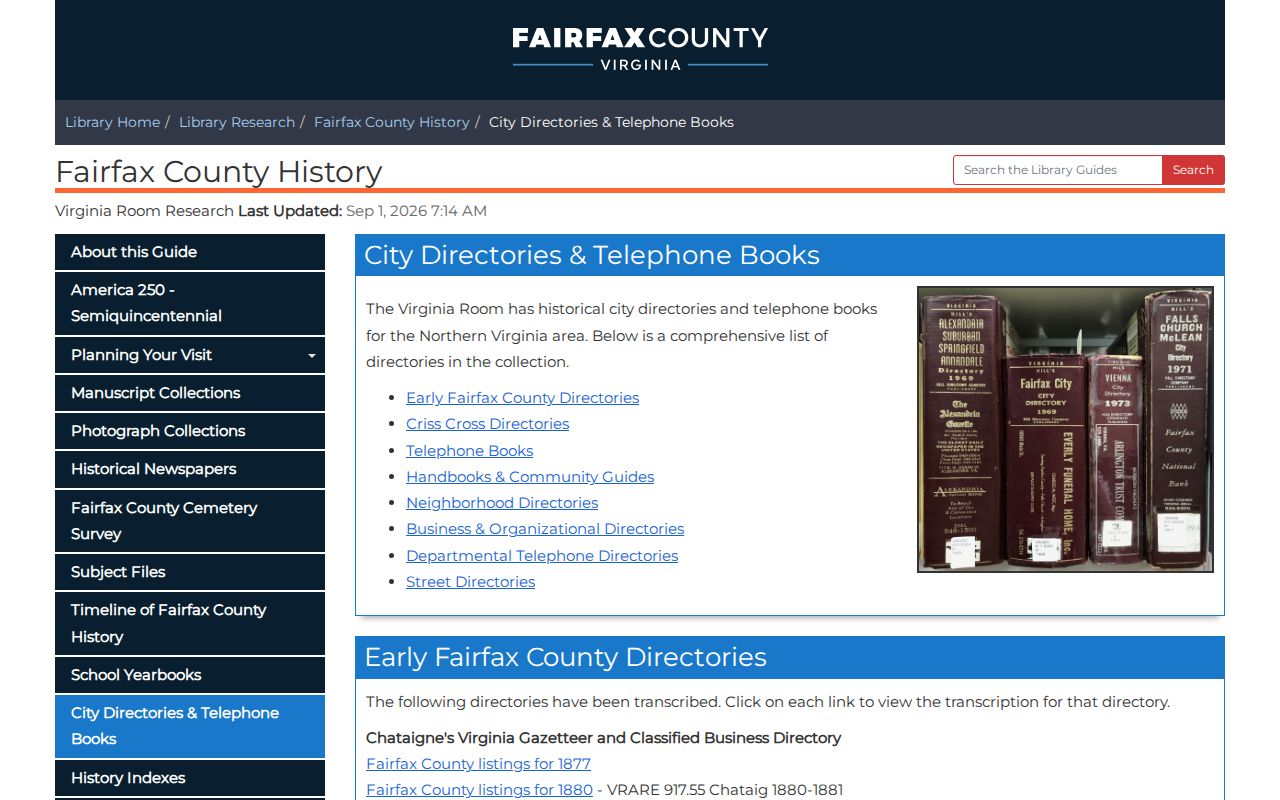
A directory listing is an annual or periodic snapshot, while a Census is a single enumeration date. A discrepancy can reflect a move, a non-subscriber, a geographic boundary, a spelling difference, or a household member not shown in a deed.
Burke House History Without a Sanborn Assumption
The Virginia Room links a guide for researching Fairfax County property history and holds maps, subject files, historical newspapers, and Historic Records Center referrals. Use those channels to date a property or test an older locality label. PLUS permits, parcel-card utility and site fields, and historic tax books can contribute dating evidence. They do not, by themselves, identify everyone who lived in a Burke house.
No Burke-specific Sanborn fire-insurance map years or direct Library of Congress item were confirmed in the official research set. That is a genuine gap. Search the Library of Congress Maps and the Virginia Room map collection using the historic locality, but do not claim that a present-day subdivision appears on a Sanborn sheet without viewing the map. This limit matters in a planned community where current streets can sit over older parcel descriptions.
Burke Deed Copies and Research Routes
When an index points to a needed instrument, Fairfax offers several access routes: CPAN for subscribers, the public CPAN terminal in the Research Room, original historical materials through the Historic Records Center, and a copy request. Give the office the instrument number or deed book and page. A personal visit can be best when the next step depends on checking an image, a related book, or a name variant. The Land Records Research Room is at 4110 Chain Bridge Road, Suite 317, Fairfax, with weekday hours stated as 8 to 4:30.
The Fairfax land-record copy instructions show the request and fee details.
For an in-person certified copy, the stated fee is $2 per document plus $0.50 per page. For mail, send the written request or Land Records Copy Request Form, the instrument or book-page details, payment, and a self-addressed stamped envelope to 4110 Chain Bridge Road, Suite 317, Fairfax, VA 22030, Attn Land Records Copies. Mail does not accept personal checks, cash, or card payment, and Fairfax states that mailed copies arrive within two weeks.