
Burke City Directory Collections
Burke is an unincorporated Fairfax County community, so there is no separate city clerk shelf or one continuous Burke city directory. The historical collection is instead a group of Fairfax gazetteers, regional reverse books, telephone volumes, and neighborhood directories. The specialized place to consult those materials is the Virginia Room at City of Fairfax Regional Library. It holds the cataloged runs, while its online directory guide identifies digitized items and explains their local geography. Use each title as cataloged. A Fairfax, Springfield, or Annandale volume can contain a Burke address without covering every Burke street.
| Collection | Years | Where held | Access |
|---|---|---|---|
| Chataigne's Virginia Gazetteer | 1877, 1880, 1884, 1888, 1890, 1897 | Virginia Room | Cataloged transcribed and digitized items |
| Hill's Virginia Gazetteer | 1906, 1911 | Virginia Room | Digitized catalog items |
| Fairfax County Virginia Directory | 1906 | Virginia Room, VRARE 917.5529 F 1906 | Digitized index route |
| Hill's Fairfax County and Alexandria Suburban criss-cross runs | 1963-1975 selected runs | Virginia Room | In-person reverse address research |
| Burke Community Directory and Burke Centre Resident Directory | 1979-1995-96 selected runs | Virginia Room | Community and association-specific volumes |
| Northern Virginia telephone and white-page books | 1910, 1938, 1942-2018 selected runs | Virginia Room, GMU, and Library of Congress items | Subscriber and selected page-image access |
The list is strong but not seamless. Burke Community Directory volumes are cataloged for 1981; 1983-84; 1984-85; 1988-89; 1989-90; 1991-92; 1992-93; 1993-94; and 1995-96. The gaps matter. A person may also be filed under Fairfax Station, Springfield, Kings Park, or another locality label. Record the directory title, year, and page before treating a result as a Burke match.
Virginia Room Directory Desk for Burke
The Virginia Room is on the second floor of City of Fairfax Regional Library, 10360 North Street, Fairfax, VA 22030. It can be reached at 703-293-6227, option 6. Regional hours are Monday through Wednesday from 10 to 9 and Thursday through Sunday from 10 to 6. Burke Centre Library is a convenient local branch, but the Virginia Room is the county's specialized genealogy and local-history desk.
The room combines city directories and telephone books with maps, historical newspapers, yearbooks, oral histories, subject files, photographs, and rare books. It has eight internet stations, a CPAN station, and a microform reader-printer with USB saving. That mix helps when a directory entry needs to be checked against a map, a newspaper notice, or an older land record. Staff can point researchers to collections, though Fairfax staff do not perform title research.
The official Virginia Room page shows the Burke city directory research setting.
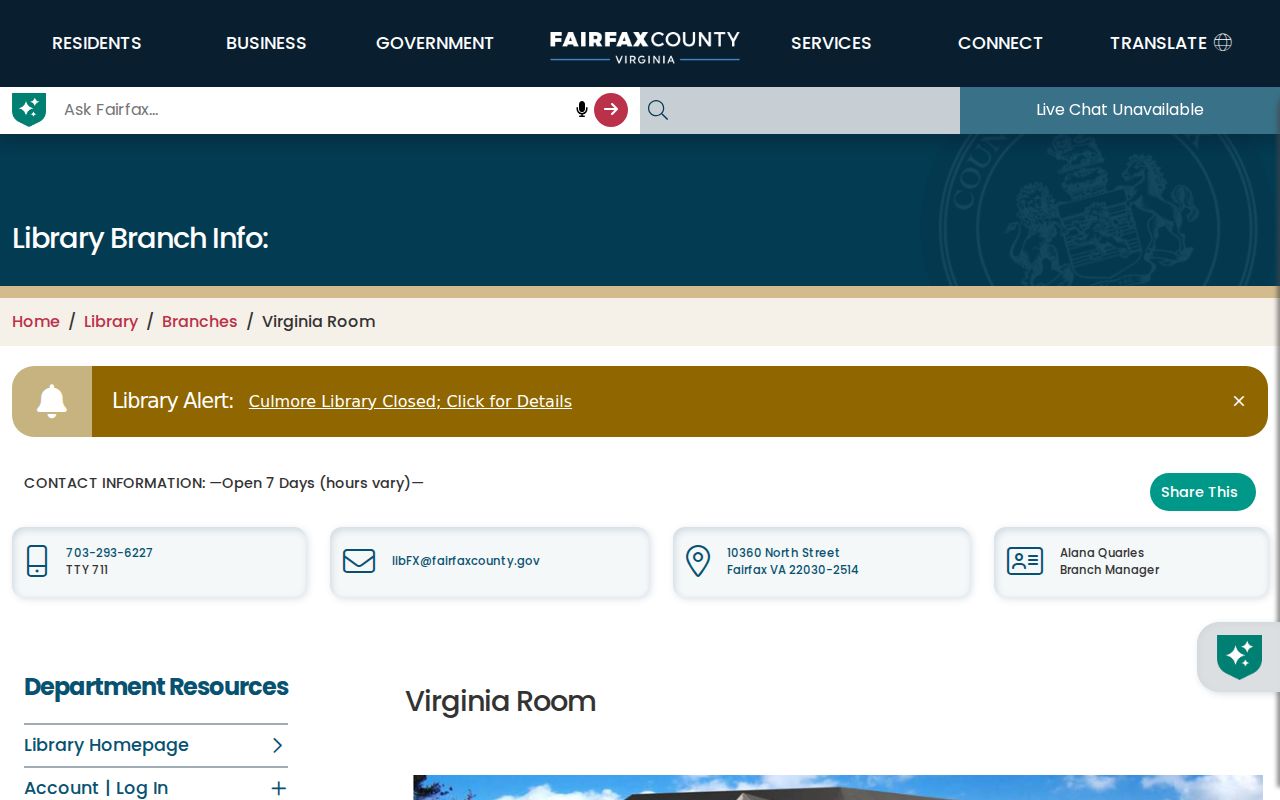
The room's local-history equipment provides the practical fallback when a digitized index points to a page but does not reveal the full printed volume.
Note: Check current accessibility and hours before a visit, because the library's branch page may carry temporary access notices.
Burke City Directory Runs by Era
For the late nineteenth and early twentieth centuries, Chataigne's Fairfax listings and Hill's Virginia Gazetteers provide names, business or locality context, not a count of every household. P.P. Mast & Co.'s 1878 farmer list adds Fairfax postal addresses but is also not a full resident roll. The 1906 Fairfax County Virginia Directory has a specific Virginia Room call number and a digitized index. It is a better starting point than assuming a book labeled for a nearby place covers Burke.
Mid-century research shifts toward telephone books and regional address books. Hill's Alexandria Suburban criss-cross volumes are held for 1966, 1968, 1969, 1971, 1972, and 1973. Hill's Fairfax City and Fairfax County run is held for 1963, 1965, 1967, 1969, 1971, 1973, and 1975. Both can supply reverse address clues, but their stated geography must be tested street by street.
Later Burke material is more direct. The Burke Centre Conservancy's Burke Centre Resident Directory is held for 1979, 1981, 1982, 1983, and 1988. It is association-specific, so membership coverage and public availability should not be read as proof of every resident in Burke Centre. Your Community Phone Book is held for 2008-09, 2009-10, 2011-12, and 2012-13 for Burke, Clifton, and Fairfax Station.
1953 Burke Telephone Snapshot
The 1953 Temporary Dial Telephone Directory is a particularly direct Burke artifact. Its Browning-8, Crescent-3, and Dunkirk-5 exchanges name Burke alongside Centreville, Clifton, Manassas, Pender, and Vienna. That shared exchange geography explains why an old listing might sit under a place name that looks unfamiliar to a present-day Burke reader. It is subscriber evidence, not a roster of everyone at an address.
The digitized Temporary Dial directory is the source for the 1953 item, while the library collection holds the surrounding telephone runs.
The Virginia Room directory collection documents the cataloged Burke and regional materials.
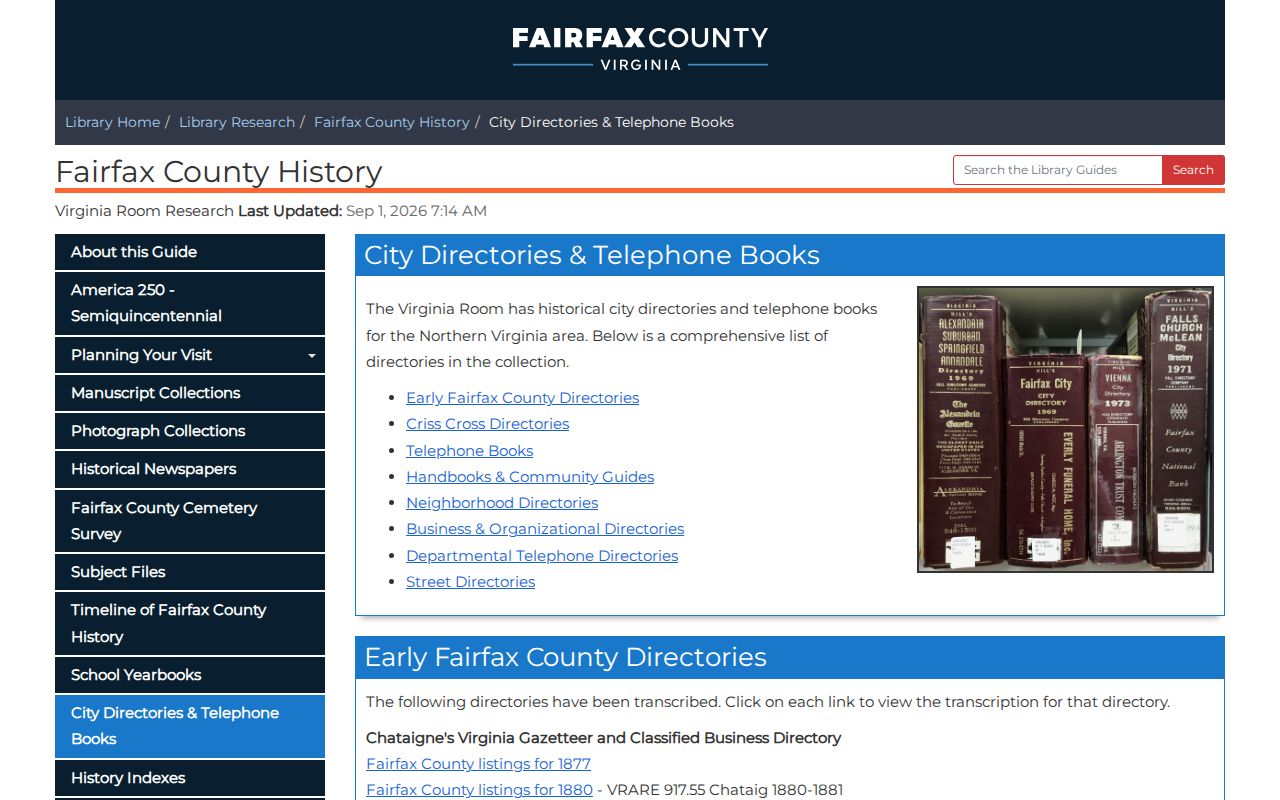
The collection list makes the key limitation visible: phone books, community directories, and regional books overlap, but none is a universal list of Burke households.
Reading a Burke City Directory Record
A careful entry transcription should not add fields the image does not support. The inspected 1906 Fairfax County Virginia Directory route is an index and PDF access point. Its verified catalog and index structure supports a person or business name, locality or address indexing context, directory year, source title, and a page or image reference. The unattended inspection did not expose one full individual image entry well enough to confirm printed spouse, work, ownership, occupancy, or widow notation. Those details should be recorded only after viewing the page.
| Person or business name | The indexed name used to locate the item. |
|---|---|
| Locality or address context | The place or address indexing context tied to the listing. |
| Directory year | The publication year needed to place the clue in time. |
| Source title | The exact directory name, which establishes its geography. |
| Page or image reference | The reference needed to return to the printed page and inspect it directly. |
In a later reverse volume, a criss-cross sequence works from street and number to an occupant or business entry. A name directory works in the other direction. Photograph or note the abbreviation key only after checking where that key appears in the particular book.
- Criss-cross directory
- A directory arranged by street and address so a researcher can work backward from a location.
- Householder index
- A name-oriented section that points from a listed household name to its entry or address.
- Abbreviation key
- The volume's own explanation of shortened labels; it should be read from that edition, not assumed from another title.
Burke Addresses in Criss-Cross Directories
Use a criss-cross book when the address is firmer than the name. Check the street number and street name first, then preserve the exact entry and directory year. The Hill's volumes are regional tools, so a Burke address might be absent because the street was outside that year's stated territory, even if nearby communities are present. A county or postal label on the cover is not a guarantee of an entry for every address.
Reverse results can be compared with deeds, tax maps, and any address change. An occupant clue does not settle ownership, and a telephone subscriber does not establish the full household. For current parcel mechanics, the Burke street directory keeps the address-centered record trail separate from these historical books.
Note: Preserve the printed locality wording, because Burke, Burke Centre, Fairfax Station, and nearby labels can describe related but different search paths.
Burke City Directories With Census
Follow a household across the available years rather than jumping from one distant listing to a conclusion. Begin with a directory year that names the person or gives a usable address. Search surname variants, initials, and household clues in the next applicable title. If a reverse book is available, repeat the address search there. Then compare the result with the nearest public federal Census, remembering that a directory is usually a yearly snapshot while a Census records one enumeration date.
- Write down the exact directory title, year, page or image, locality, and address context.
- Search the next available year, not an assumed annual run, and keep a separate note for a missing volume.
- Use a criss-cross volume to test the address when the title states that it includes the relevant Burke area.
- Pair 1877 through 1897 directories with the 1880 or 1900 Census, and pair 1906 or 1911 with the 1910 Census.
- For later material, compare mid-century telephone or reverse directories with the 1940 or 1950 Census, subject to the federal 72-year release rule.
A disappearance can reflect an unlisted phone, a geography limit, a spelling variation, vacancy, a move, or a different postal locality. Fairfax's historical newspaper index, probate material, cemetery research, and deeds can test those alternatives. The point is to retain the gap as evidence instead of filling it with a guess.
Burke City Directory Timeline
The cataloged record is a series of surviving collections, not a promise of annual Burke coverage. These points help choose the first likely source for a particular family or address. They also show why a family-history search may shift from county gazetteers to telephone books and then to smaller community titles.
- 1877-1897: Chataigne's Fairfax listings begin the researched gazetteer sequence.
- 1906 and 1911: Fairfax County Virginia Directory and Hill's Virginia Gazetteer provide early county-era entries.
- 1953: The Temporary Dial Telephone Directory supplies a Burke-specific telephone exchange artifact.
- 1963-1975: Selected Hill's county and criss-cross books provide regional reverse-address paths.
- 1979-2012-13: Burke Centre, Burke Community, and later community phone-book runs add local snapshots with cataloged gaps.
There is no verified final year for a comprehensive Burke city directory. The published sequence should therefore be treated as a research timeline, not as a complete list of every year or every Burke household.
Burke Directory Place Names Over Time
Burke's name carries its own record-search complication. Official county history links Burke Station on the Orange and Alexandria Railroad to Silas Burke. Historic address clues may therefore use Burke Station, Old Burke Lake, Burke Road, Fairfax Station, or other nearby locality wording. A match for the name Burke can also be a locality, a road, a conservancy entity, or an unrelated surname. Add a year, street, middle initial, or document type before treating it as a person match.
The research set begins its Fairfax directory era in 1877, continues through the 1906 and 1911 county materials, and reaches Burke-specific community books in 1979. Cataloged community and phone books run to 2012-13, but no verified last printed year for one comprehensive Burke city directory was located. That absence is a useful boundary when building a family timeline.